
Aircraft marshalling jobs UK applicants search for are an important part of safe aircraft movement on the ground. A marshaller uses internationally standardised hand or illuminated-wand signals to guide pilots when aircraft are moving onto, around or away from parking positions where normal visual guidance is insufficient.
The role looks distinctive because the marshaller is highly visible in front of an aircraft, but UK recruitment does not always treat marshalling as a separate occupation. At many airports, it forms part of a wider ramp-agent or ground-operations role involving baggage, aircraft turnaround, ground equipment, stand preparation and airside driving.
That distinction matters when looking for work. Searching only for “aircraft marshaller” may reveal fewer vacancies than searching for ramp agents whose responsibilities include marshalling.
This guide explains what an aircraft marshaller does, the skills and training required, current security expectations, likely pay and how to find opportunities in UK aircraft ground operations.
What Is an Aircraft Marshaller?
An aircraft marshaller is a trained member of ground staff who provides visual guidance to an aircraft pilot during ground movement.
The marshaller normally positions themselves where the flight crew can see the signals clearly and uses prescribed arm movements, often with illuminated wands in darkness or reduced visibility.
The signals tell the pilot to perform actions such as:
- continue ahead;
- turn;
- slow down;
- stop;
- shut down engines; or
- position the aircraft as directed.
Marshalling is particularly useful when an aircraft is approaching a stand that does not have an operational Visual Docking Guidance System, often abbreviated to VDGS, or where local conditions make manual guidance appropriate.
It should not be confused with air traffic control.
Air traffic controllers manage aircraft movements within their operational responsibilities, while the marshaller provides close visual guidance on the apron or stand.
What Does an Aircraft Marshaller Do?
The visible hand signals are only the final part of the task.
Before an aircraft arrives, the marshaller needs to confirm that the allocated stand is ready and that the path the aircraft will follow is clear.
Foreign objects, vehicles, equipment or badly positioned ground-support machinery can create collision risks.
The marshaller then takes up the correct position and establishes clear visual communication with the flight crew.
Once the aircraft is moving under guidance, the marshaller must maintain awareness of:
the aircraft’s nose and wings, obstacles, stand markings, other ground equipment and the actions of people working nearby.
Communication continues until the aircraft reaches its intended position and the appropriate stop signal is given.
Depending on the employer, the same person may then perform other ramp duties, such as placing cones or chocks, handling baggage or supporting aircraft servicing.
Why Aircraft Marshallers Are Important
Airport aprons are busy, constrained environments.
Aircraft may be manoeuvring within metres of terminal buildings, passenger steps, baggage equipment, fuel vehicles and other aircraft.
Pilots have limited visibility from the cockpit, particularly of areas close to wing tips, landing gear and the ground immediately around the aircraft.
A marshaller provides a visible human reference.
CAA guidance recognises marshalling as part of safe apron management and expects trained personnel to use standard signals.
The task becomes particularly important when:
- a stand lacks automatic docking guidance;
- docking equipment is unavailable;
- a pilot is unfamiliar with the airport;
- local routing is unusual;
- visibility is reduced; or
- airport procedures require manual guidance.
Good marshalling helps protect aircraft, people and infrastructure while supporting efficient aircraft ground operations.
Key Duties and Responsibilities
A marshaller’s responsibilities vary according to whether marshalling is a dedicated airport function or part of a broader ramp job.
Typical responsibilities can include:
- checking the stand before aircraft arrival;
- carrying out foreign-object-debris checks;
- making sure equipment is clear of the aircraft path;
- guiding aircraft using approved signals;
- coordinating with wing walkers where required;
- positioning aircraft accurately on the stand;
- reporting hazards or equipment faults;
- working with ramp supervisors and turnaround teams;
- wearing required high-visibility clothing and PPE;
- complying with airside safety rules; and
- maintaining awareness of aircraft and vehicle movements.
In a wider ramp role, responsibilities may also include loading and unloading baggage, operating belt loaders or tugs, placing chocks and cones, conducting departure checks and supporting pushback.
This is why many advertised airport ramp jobs include marshalling without using the word “marshaller” in the job title.
A Typical Day as an Aircraft Marshaller
The working day is driven by aircraft movements.
At the beginning of a shift, staff may receive a briefing covering weather, stand allocation, expected workload, operational changes and safety issues.
Equipment is checked before use, and employees move to the required aircraft stands according to arrival schedules.
Before an aircraft approaches, the stand needs to be ready.
The marshaller checks that the parking area and intended movement path are free from equipment or debris that could endanger the aircraft.
When the aircraft arrives, attention becomes highly focused. The marshaller positions themselves where the pilot can see them and begins using standardised signals.
Once the aircraft is safely parked, other turnaround activities begin or continue.
If marshalling is only one part of a ramp-agent role, the worker may immediately switch to unloading baggage, positioning equipment or completing another turnaround task.
A busy shift can involve several aircraft in quick succession.
Delays and stand changes can also alter the planned workload with little notice, so staff need to remain adaptable without taking procedural shortcuts.
Aircraft Marshaller Skills and Personal Qualities
Marshalling is not complicated because it requires advanced mathematics or academic qualifications. It is demanding because small errors in judgement can matter around moving aircraft.
Situational awareness
A marshaller must constantly understand what is happening around the aircraft.
Looking only at the cockpit is not enough. Wing clearance, vehicles, equipment and other personnel all matter.
Concentration
Signals must remain deliberate and unambiguous.
A moment of distraction during an aircraft movement is very different from losing concentration during routine office work.
Clear communication
Although marshalling relies heavily on visual signals, the wider job involves communication with supervisors, ramp teams and operational staff.
Ability to follow procedures
Aircraft movements are not an appropriate environment for personal improvisation.
Workers need to use approved signals and local operating procedures consistently.
Confidence without recklessness
A good marshaller must be visible and decisive enough for the pilot to understand the guidance, while remaining willing to stop an operation if conditions are unsafe.
Teamwork
Marshalling can involve wing walkers, ramp staff, pilots and other airport teams.
Physical capability
The job is primarily outdoors and can involve prolonged standing, walking and other physical ramp work.
Reliability
Airport operations depend on employees being present for early starts, nights, weekends and public holidays.
Aircraft Marshaller Job Requirements
There is no single national academic qualification that every UK aircraft marshaller must hold before applying.
The precise requirements depend on the employer and whether the vacancy is a dedicated marshalling post or, more commonly, a ramp role that includes marshalling.
Current ramp agent jobs can ask for:
- a full UK driving licence;
- good spoken and written English;
- a checkable five-year work and education history;
- ability to pass criminal-record and airside-security checks;
- physical ability to perform ramp duties;
- shift flexibility;
- good communication skills; and
- strong safety awareness.
Previous aviation experience is often useful but is not universally essential.
Swissport, Loganair and other current employers provide training for successful recruits, while some job adverts specifically describe previous ramp experience as desirable rather than mandatory.
A driving licence appears frequently because ground staff may operate vehicles or equipment airside.
However, the requirement comes from the wider job and local operation rather than from a rule stating that every person who gives a marshalling signal must hold the same driving licence.
How to Become an Aircraft Marshaller in the UK
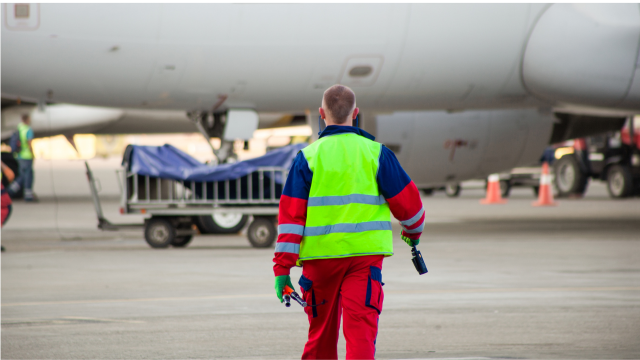
The most practical route is often to enter airport ground handling rather than wait for a vacancy titled simply “Aircraft Marshaller”.
Start by searching for:
Ramp Agent, Airside Ramp Agent, Ground Handling Agent, Ramp Operative, Aircraft Services Agent and Ground Operations Agent.
Read the responsibilities for references to aircraft marshalling, wing walking, aircraft stand guidance or turnaround operations.
Next, check whether you meet the basic recruitment conditions.
If the role requires a manual driving licence and you do not have one, your options may be limited at some airports.
Prepare your five-year work and education history carefully because airside pass applications often require gaps to be explained.
When applying, emphasise evidence of:
safety-conscious work, procedure-following, teamwork, shift reliability, driving experience, physical work and calm decision-making.
If successful, the employer should provide the relevant airport and marshalling training before you are authorised to work independently.
Aircraft Marshalling Signals and Procedures
Aircraft marshalling uses standardised signals rather than locally invented gestures.
UK Standardised Rules of the Air contain the recognised signal set used by a signalman or marshaller.
Signals include instructions relating to:
- wing-walker guidance;
- identification of the gate or stand;
- proceeding ahead;
- turning left or right;
- slowing down;
- stopping;
- applying or releasing brakes;
- chocks;
- engine start and shutdown; and
- emergency situations.
The precise form of each signal matters.
Someone cannot learn safe aircraft marshalling simply by watching airport videos and copying what appears to happen.
CAA guidance requires standard signals, and marshallers should be properly trained, tested and authorised.
Before signalling begins, the marshaller must also ensure that the area within which the aircraft is to be guided is clear of obstacles.
Why standardisation matters
Pilots operate internationally.
A signal used at Manchester needs to mean the same thing to a flight crew that has just arrived from Madrid, Dubai or New York.
Standardisation reduces ambiguity.
That is why exaggerated homemade signals or personal shorthand have no place in professional marshalling.
Aircraft Stand and Ground Operations
The aircraft stand is the working area in which an aircraft parks for servicing, boarding or turnaround.
Once an aircraft arrives, multiple activities can occur within a confined space.
These may include:
baggage loading, catering, fuelling, cabin cleaning, passenger steps, ground power, water servicing and engineering work.
Safe stand management therefore depends on coordination.
Before arrival, ground equipment should be positioned where it will not obstruct the aircraft.
Foreign object debris should be removed.
Personnel must remain clear of hazardous areas around engines, propellers, wheels and moving aircraft.
After parking, chocks and cones may be placed according to local procedures.
Before departure, equipment and personnel must again be clear before pushback or aircraft movement begins.
An aircraft marshaller needs to understand this wider environment because aircraft guidance cannot be separated from the activity taking place around the stand.
Aircraft Marshalling Safety Requirements
Aircraft can cause severe injury even at relatively low ground speeds.
Marshaller training therefore covers more than remembering arm signals.
One important hazard is jet blast. Exhaust from aircraft engines can injure people or move unsecured objects and equipment.
Intake areas are another serious risk because operating engines can draw objects or people towards them.
Propeller aircraft introduce additional hazards that may be difficult to see, particularly in poor light.
Aircraft wheels and brakes also require caution. CAA guidance warns that ramp personnel should keep clear of wheels while aircraft are moving, and brake assemblies can remain extremely hot after arrival.
High-visibility clothing helps flight crews and vehicle drivers see ground staff.
Hearing protection, safety footwear and other PPE may also be required according to the employer’s assessment and activity.
The central principle is simple: no departure deadline justifies guiding an aircraft through an unsafe stand.
If conditions are not safe, the movement should be stopped or delayed according to procedure.
Aircraft Marshaller Training
CAA guidance states that aerodrome operators should provide for the training, testing and authorisation of marshallers, although training can also be delivered through approved handling organisations or third-party employers.
The guidance is particularly clear that only trained and experienced marshallers in regular practice should marshal aircraft unsupervised.
Training can cover:
- standard marshalling signals;
- stand layout and markings;
- aircraft characteristics;
- wing-tip and obstacle clearance;
- use of illuminated wands;
- communication procedures;
- wing walking;
- PPE;
- foreign-object-debris control;
- jet blast and engine hazards;
- low-visibility procedures; and
- emergency stop signals.
Practical training matters because the employee has to demonstrate signals clearly and interpret real aircraft movement.
A knowledge quiz cannot by itself demonstrate competent marshalling.
Employees may also require recurrent checks or refresher training under local airport procedures so their competence remains current.
Airport Security Clearance Requirements
Aircraft marshalling normally takes place airside, so security screening is a major recruitment consideration.
For jobs requiring unescorted access to a Security Restricted Area, a basic criminal-record check may be required.
Background screening generally includes verification of:
- identity;
- employment history;
- education;
- unexplained gaps; and
- relevant criminal-record information
covering at least the previous five years.
Applicants who have lived abroad continuously for six months or more during that five-year period may need appropriate overseas criminal-record certificates.
Some workers also require an Accreditation Check depending on the role and access involved.
The process is normally connected to the employer and airport-pass application.
It is therefore inaccurate to tell applicants simply to “get airport security clearance” before applying as if one generic certificate were transferable between every UK airport.
Current vacancies often ask candidates to provide the information needed for clearance after recruitment progresses.
Aircraft Marshaller Salary in the UK
There is no single reliable national pay rate specifically for aircraft marshallers.
A major reason is that marshalling is frequently included within a broader ramp-agent position.
Current 2026 vacancy examples provide a more realistic picture.
Swissport’s current Manchester ramp role pays £13.52 per hour and includes aircraft-handling responsibilities. A Belfast Swissport ramp role has been advertised at £12.91 per hour and specifically includes marshalling aircraft.
Recent Bristol ramp recruitment has advertised £14.43 per hour, while a Castle Donington ramp position including aircraft marshalling was advertised at £16.70 per hour.
At Sumburgh Airport, Loganair’s current full-time ramp-agent vacancy — which includes aircraft marshalling — is listed at approximately £36,275 per year.
This variation shows why salary websites quoting one national “marshaller salary” should be treated cautiously.
Pay can depend on:
- airport;
- employer;
- contracted hours;
- shift premiums;
- overtime;
- airside driving responsibility;
- ground-equipment authorisations; and
- whether the employee performs broader ramp functions.
Applicants should compare actual current vacancies rather than relying on one national average.
Working Hours and Conditions
Aircraft ground handling follows airline schedules rather than normal office hours.
Marshallers and ramp agents may work:
early mornings, evenings, overnight shifts, weekends and bank holidays.
Rotating rosters are common.
The work is also outdoors.
Rain, wind, cold and summer heat do not automatically stop aircraft turnarounds, although severe weather may change operating procedures.
Noise levels can be high and the working environment is highly active.
Employees may spend part of a shift carrying baggage, driving equipment or completing physical ground tasks before being required to concentrate fully on an approaching aircraft.
Travel to work is another practical consideration.
Airport shifts can begin before public transport starts. Applicants should check whether they can reliably reach the airport at 3 am or return home after a late finish rather than considering only the advertised salary.
Career Progression in Airport Ground Operations

Marshalling experience can become part of a broader ground-operations career.
A ramp agent who develops a strong safety record and multiple equipment authorisations may progress towards roles such as:
- senior ramp agent;
- team leader;
- ramp supervisor;
- turnaround coordinator;
- aircraft dispatcher;
- ground-operations controller;
- airside operations officer; or
- ground-handling trainer.
Some routes require additional licences, training or operational experience.
Airside operations positions may involve inspections, wildlife control, stand management or other aerodrome-safety responsibilities.
Supervisory roles also introduce responsibility for staff, workflow and safety performance.
There may be opportunities to move between departments as well.
Experience in aircraft ground operations can be relevant to baggage, dispatch, cargo, passenger services, ground equipment and other areas of airport work.
Progression is not automatic, but ramp experience gives employees a practical understanding of how an airport works around an aircraft.
How to Find Aircraft Marshaller Jobs
Use several job titles when searching.
Dedicated “marshaller” vacancies are relatively uncommon, so relying on that phrase alone may miss much of the market.
Search for:
aircraft marshaller, ramp agent, airside ramp agent, ground handling agent, ramp operative, ground operations and aircraft services.
Then read the duties.
A ramp-agent advertisement may explicitly mention:
“marshal aircraft”, “aircraft marshalling signals”, “wing walking” or “aircraft stand guidance”.
Look at employer career sites as well as general recruitment platforms.
Ground handlers such as Swissport and Menzies recruit directly, while airlines including Loganair may operate their own ground-handling teams at particular airports.
Airport careers pages can also point towards companies based on site.
Set job alerts if possible because recruitment often rises around seasonal schedules and new airline or handling contracts.
Tips for Applying for Aircraft Marshalling Jobs
Tailor your application around airport operations rather than writing a generic CV.
Put a full manual driving licence prominently on the CV if the vacancy requires one.
Make your shift availability clear.
Give evidence that you can follow procedures under pressure.
For example, experience in logistics, warehousing, construction, transport, emergency services or another safety-sensitive environment can be highly relevant.
Prepare accurate dates for your previous five years of work, education and unemployment.
Do not leave unexplained gaps and assume they can be sorted out later.
If you have no airport experience, focus on transferable evidence rather than pretending otherwise.
Useful examples include:
- working safely around moving vehicles;
- following standard operating procedures;
- communicating clearly in noisy environments;
- meeting time-critical deadlines;
- identifying hazards;
- completing physical work; and
- staying calm when plans change.
Finally, show that you understand marshalling is a safety function.
Employers are unlikely to be impressed by someone whose main motivation is simply “standing next to planes”.
Common Aircraft Marshaller Interview Questions
“What is the main responsibility of an aircraft marshaller?”
A strong answer focuses on safely guiding aircraft using approved signals while maintaining awareness of the stand, obstacles and surrounding ground activity.
“What would you do if an object appeared in the aircraft’s path?”
The correct principle is to stop the aircraft movement using the appropriate procedure rather than assuming there is enough clearance.
“How would you deal with pressure from a delayed flight?”
Explain that you would work efficiently but would not bypass safety procedures to recover time.
“Why are standard marshalling signals important?”
They provide a recognised communication system that pilots and trained ground staff can interpret consistently.
“Tell us about a time you identified a safety risk.”
Choose a real example, explain what you noticed, what action you took and what happened afterwards.
“Can you work nights, weekends and early mornings?”
Answer truthfully and be ready to explain how you will travel to the airport outside normal public-transport hours.
“What would you do if you did not understand an instruction?”
Clarify it rather than guessing. That approach is particularly important in safety-critical work.
“Why do you want to work in airport ground operations?”
Show that you understand the physical, procedural and shift-based nature of the occupation rather than describing aviation only as exciting or glamorous.
Key Takeaways
Aircraft marshalling jobs UK candidates search for are often embedded within wider ramp-agent and ground-handling positions rather than advertised as stand-alone careers.
An aircraft marshaller guides pilots using standardised signals and must first ensure that the area through which the aircraft will move is clear.
CAA guidance expects marshallers to be trained, tested and authorised, with only trained and experienced personnel in regular practice working unsupervised.
Formal university qualifications are not usually the main barrier to entry. Employers commonly focus on driving ability, safety awareness, communication, physical capability, shift flexibility and airside-security eligibility.
Current ramp roles incorporating marshalling show considerable variation in pay, from around £13 an hour in some locations to higher hourly rates or annual packages depending on airport and responsibilities.
Security screening can require a five-year checkable history and criminal-record checks.
For most new entrants, applying for ramp agent jobs is likely to provide more opportunities than searching only for dedicated marshaller positions.
Frequently Asked Questions
What does an aircraft marshaller do?
An aircraft marshaller uses standard visual signals to guide an aircraft safely during ground movement, particularly when entering or leaving a parking position.
The marshaller checks that the movement area is clear and communicates instructions to the flight crew using approved arm or wand signals.
In many UK jobs, marshalling is one responsibility within a wider ramp-agent role.
How do I become an aircraft marshaller in the UK?
Look for aircraft-marshalling and ramp-agent vacancies with airports, airlines and ground-handling companies.
Successful applicants normally complete employer and airport training before being authorised to marshal aircraft independently.
A driving licence, five-year checkable history, security eligibility and ability to work shifts are common requirements in current ramp recruitment.
What qualifications are needed for aircraft marshalling?
There is no universal degree or academic qualification required for every UK marshalling role.
CAA guidance focuses on proper training, testing and authorisation.
Employers may also require a full driving licence, adequate English communication, physical capability and successful airside screening.
Previous aviation experience can help but is not required by every employer.
How much does an aircraft marshaller earn?
Because aircraft marshalling is frequently included within ramp work, there is no dependable single national salary.
Current UK ramp roles involving marshalling range from roughly £12.91 to £16.70 per hour in several live examples, while a current Loganair Sumburgh ramp role is advertised at £36,275 a year.
Rates vary by airport, employer, hours, shifts and responsibilities.
What skills does an aircraft marshaller need?
Important skills include situational awareness, concentration, communication, teamwork, procedural discipline and the confidence to stop an operation if conditions are unsafe.
Physical fitness and flexibility for outdoor shift work are also useful for broader ramp positions.
Do aircraft marshallers need security clearance?
Marshallers working unescorted in Security Restricted Areas normally need to meet applicable aviation-security requirements.
These can include identity checks, a basic criminal-record disclosure and verification of employment, education and gaps covering at least the previous five years.
The exact airport-pass process depends on the role and airport.
What training is required for aircraft marshalling?
Training should cover recognised marshalling signals, stand safety, aircraft hazards, positioning, wing clearance, local airport rules and emergency procedures.
Practical assessment is important because marshalling competence must be demonstrated rather than inferred from theoretical knowledge alone.
Tyne Academy aviation courses can provide introductory learning about airport and airline operations, but their completion certificates do not replace practical marshaller training or authorisation.
What are the career opportunities for aircraft marshallers?
Marshalling and ramp experience can support progression into senior ramp, supervision, turnaround coordination, dispatch, airside operations and training roles.
Larger aviation companies can also offer sideways movement into other airport-operational functions.
Further advancement depends on experience, vacancies and any additional licences or training required.

Conclusion
Aircraft marshalling jobs UK airports offer combine precision, communication and strong safety awareness in one of the most visible parts of aircraft ground operations.
The marshaller’s task is not simply to wave an aircraft into position. The stand must be checked, clearance maintained and only recognised signals used. CAA guidance makes clear that marshallers should be properly trained, tested and authorised before they operate unsupervised.
For applicants, an important practical lesson is that dedicated aircraft marshaller vacancies are less common than broader ramp agent jobs that include marshalling. Searching the wider ground-handling market can therefore reveal considerably more opportunities.
Employers commonly value a full driving licence, reliable shift availability, communication, attention to safety and the ability to obtain an airside pass. Previous aviation experience can be useful, but current recruitment shows that some employers provide the necessary ground-handling training to new entrants.
Tyne Academy’s aviation learning can provide background understanding of airport operations, safety and the wider industry for someone preparing to explore this career. Its online completion certificates should not, however, be confused with practical marshaller authorisation, airport security clearance or evidence that someone can safely guide an aircraft.
For applicants who are comfortable working outdoors, following precise procedures and taking responsibility in a fast-moving environment, aircraft marshalling can be a valuable operational skill and a strong entry point into the wider world of airport ramp jobs.