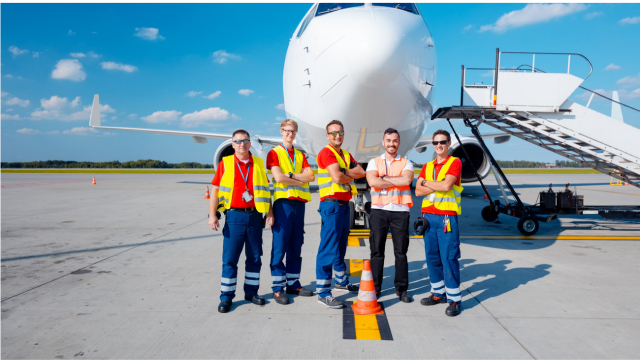
Airport ramp agent jobs UK airports advertise are among the most hands-on roles in commercial aviation. Ramp agents work around aircraft during the relatively short period between arrival and departure, helping unload and load baggage and cargo, position ground equipment, marshal aircraft and complete other servicing tasks required for a safe departure.
The work is physical, outdoors and highly time-sensitive. A delayed flight may create pressure to work quickly, but departure time never removes the need to follow safety procedures around aircraft engines, vehicles, baggage equipment and other ground teams.
Entry requirements are often more accessible than people expect. A university degree is not normally required, and some employers recruit people without previous airport experience. A full driving licence, reliable shift availability, physical capability, attention to safety and the ability to pass the relevant airside security checks are often more important.
This guide explains what ramp agents do, current job requirements and pay, the realities of aircraft turnaround work and the opportunities available for building longer-term ramp agent careers.
What Is an Airport Ramp Agent?
An airport ramp agent is a ground-handling employee who works around aircraft on the airport apron or ramp.
The “ramp” is the operational area where aircraft park and are prepared for their next flight. Passengers may see ramp agents loading bags beneath the aircraft or driving baggage equipment, but those visible tasks are only part of the job.
Depending on the employer and airport, a ramp agent may handle:
- passenger baggage;
- air cargo and mail;
- aircraft marshalling;
- ground-support equipment;
- aircraft servicing;
- loading documentation; and
- turnaround safety checks.
Job titles vary. Similar work may be advertised as Airside Ramp Agent, Ground Handling Agent, Ramp and Baggage Agent, Aircraft Services Agent or Ground Operations Agent.
That matters when job hunting. Searching only for “ramp agent” can miss otherwise suitable ground handling jobs.
What Does a Ramp Agent Do?
A ramp agent helps prepare an aircraft for departure after it arrives at the stand.
One of the first jobs may be unloading baggage, cargo and mail from the arriving flight. Departing baggage is then loaded according to the operational plan.
At the same time, other teams may be fuelling the aircraft, supplying catering, cleaning the cabin, boarding passengers or completing engineering work.
Ramp staff therefore operate within a tightly coordinated system.
Depending on their training and authorisation, they may also drive tugs, position belt loaders, tow baggage carts, place wheel chocks and cones, marshal aircraft or assist with pushback.
Some employers combine even more functions. Current ramp vacancies include duties such as potable-water replenishment, lavatory servicing and occasional cabin-related tasks.
The exact role should always be taken from the employer’s job description rather than from a generic definition.
Why Ramp Agents Are Important to Airport Operations
Aircraft generate revenue when they are flying, not when they are sitting unnecessarily on the ground. Airlines therefore plan turnarounds carefully.
That makes ramp work an important link between arrival and departure.
Consider what has to happen after a passenger aircraft reaches its stand. Incoming bags need to be unloaded. Outbound bags must arrive from the sorting system. Cargo and mail may need transferring. Aircraft servicing equipment has to approach safely. Passengers may be leaving from one side of the operation while preparation for the next flight begins elsewhere.
One badly positioned vehicle or incorrectly handled load can disrupt the whole process.
Ramp agents also protect safety.
The CAA treats aircraft turnaround as an environment containing numerous interacting hazards. Ramp staff need to understand aircraft movement, jet blast, engines, moving vehicles, equipment positioning and restricted areas around the aircraft.
The job is therefore both logistical and safety-critical.
Key Duties and Responsibilities
The exact responsibilities differ between employers, but current UK vacancies show a consistent core of operational duties.
Ramp agents commonly load and unload baggage, cargo and mail, operate authorised ground-service equipment and work with colleagues to prepare aircraft for arrival and departure.
Other responsibilities can include:
- marshalling aircraft;
- moving baggage carts and dollies;
- positioning belt loaders;
- placing or removing chocks and cones;
- checking the stand for foreign object debris;
- supporting aircraft servicing;
- reporting damaged baggage or equipment;
- following hazardous-material procedures;
- completing required operational paperwork; and
- communicating with supervisors, dispatchers and other ground teams.
Some activities require specific training or authorisation.
Being employed as a ramp agent does not automatically mean someone is qualified to drive every vehicle, perform pushback or operate every item of ground-support equipment.
Employees should work only within the duties for which they have been trained and authorised.
A Typical Day as an Airport Ramp Agent
A ramp shift tends to follow flight movements rather than a predictable office routine.
At the start of a shift, staff may receive a briefing, equipment allocation and details of the flights they will handle.
Before an aircraft arrives, the stand needs to be ready. Equipment should be positioned safely, unnecessary objects removed and the team prepared for the incoming aircraft.
Once the aircraft is secure, unloading starts.
Baggage from the arriving flight may be removed from the hold and transferred onto carts for transport to the baggage system. Cargo and mail can require separate handling.
The next load then needs to go aboard.
Between these activities, the worker may operate equipment, communicate with colleagues or perform another servicing task.
A delayed inbound aircraft can create sudden pressure because the airline may still aim for an on-time departure.
Good ramp staff respond by working efficiently and communicating well, not by skipping safety checks.
After one departure, the team moves to its next assignment.
Airport Ramp Agent Skills and Personal Qualities
Employers need people who can be trusted in a fast-moving operational environment.
Safety awareness
Aircraft, engines, specialist vehicles and heavy baggage create obvious hazards. Following procedures consistently is fundamental.
Teamwork
No ramp agent completes an aircraft turnaround alone. Ground operations depend on coordinated work between multiple employees and organisations.
Situational awareness
Workers need to notice moving vehicles, approaching equipment, operating engines and other activity around the stand.
Physical stamina
Ramp jobs involve lifting, bending, pushing, pulling, climbing and working inside aircraft holds.
Communication
Instructions need to be heard and understood accurately, sometimes in a noisy environment.
Time management
Turnarounds have deadlines. Employees must organise tasks efficiently without creating unsafe shortcuts.
Reliability
A team cannot simply leave an aircraft half-loaded because someone regularly fails to arrive for an early shift.
Adaptability
Aircraft can change stands, bags can arrive late and weather can disrupt plans. Ramp workers need to adjust without losing procedural control.
These practical qualities often matter more than academic achievement when employers recruit for entry-level airport ramp jobs.
Ramp Agent Job Requirements in the UK
There is no single nationwide qualification required for every ramp-agent position.
Current vacancies typically focus on practical requirements.
A full UK manual driving licence is common because ramp agents may drive vehicles or ground-support equipment. Swissport’s current Manchester, Belfast and Leeds Bradford vacancies all make a driving licence a requirement.
Applicants may also need:
- the legal right to work in the UK;
- a checkable employment and education history;
- ability to pass relevant background checks;
- flexibility for rotating shifts;
- sufficient physical capacity for baggage work;
- good communication skills; and
- ability to follow safety and security procedures.
Previous ramp or aviation experience is useful but not universally mandatory.
Current Swissport vacancies state that similar experience is preferred but not required.
That makes ramp work potentially accessible to applicants coming from logistics, warehousing, delivery, construction, hospitality or other physically active jobs.
Individual vacancies can impose additional requirements, so the person specification always takes priority.
How to Become an Airport Ramp Agent
Start by looking at airport ramp jobs you can genuinely reach at unusual hours.
A vacancy may look ideal until you discover that its 4 am start is impossible using local public transport.
Next, search airline, ground-handler and airport ramp jobs careers pages.
Large ground-handling companies employ significant numbers of ramp workers on behalf of airlines.
Review several current vacancies to identify recurring requirements. If nearly every suitable role asks for a full manual driving licence, obtaining one may materially improve your prospects.
Prepare a straightforward CV that emphasises evidence of:
physical work, reliable attendance, shift work, safety procedures, vehicle operation, teamwork and meeting time-sensitive targets.
Do not assume lack of airport ramp jobs experience disqualifies you.
Instead, show how your existing work translates.
Someone from a warehouse may already understand manual handling, loading deadlines and vehicle movements. A delivery driver may have strong safety and time-management experience.
Successful applicants then complete the employer’s airport ramp jobs-specific training before carrying out independent ramp duties.
Aircraft Loading and Unloading Duties
Baggage handling is one of the most physically demanding parts of ramp work.
Bags may be moved from baggage carts onto a belt loader and then stacked inside the aircraft hold.
The hold itself can be a challenging environment.
Workers may need to kneel, bend or work in restricted space while moving baggage repeatedly.
HSE identifies several manual-handling risk factors, including baggage weight, frequency of lifting, pushing and pulling equipment and working with bags below knee height or above shoulder height.
Mechanical aids should therefore be used where appropriate.
Aircraft loading also has an operational dimension.
Baggage and cargo cannot simply be placed wherever there is free space. The aircraft must be loaded according to applicable instructions so that weight and balance requirements are maintained.
Ramp agents should follow the loading information and procedures supplied to them rather than making independent assumptions about load distribution.
Baggage and Cargo Handling Responsibilities
Passenger baggage is only one type of load moved through an airport ramp jobs
Ramp agents can also handle mail, freight, mobility equipment and special baggage.
Different items can require different procedures.
For example, a wheelchair or mobility aid may need careful handling so that it reaches the passenger intact. Sporting equipment may have unusual dimensions. Cargo can involve specialist containers, documentation or dangerous-goods requirements.
Ramp staff are also part of the chain that connects the terminal baggage system with the correct aircraft.
A bag placed on the wrong flight creates disruption for both the passenger and airline.
Accuracy therefore matters alongside speed.
Cargo-focused roles can involve additional warehouse responsibilities. Current Stansted recruitment, for example, combines ramp work with cargo storage, pallet preparation and checking cargo paperwork.
Employees working with regulated dangerous goods require appropriate training for the responsibilities they perform.
Ramp Equipment and Vehicle Operations
Modern ramp work depends heavily on ground-support equipment.
A typical agent may encounter equipment such as:
baggage tugs for towing carts;
baggage carts and dollies for transporting bags or cargo;
belt loaders for moving baggage between ground level and the aircraft hold;
passenger steps where an airbridge is not used;
ground power units for providing electrical power to parked aircraft; and
pushback equipment for moving aircraft away from stands.
Not every employee is authorised to use every item.
Equipment operation requires training, and airside driving may require the airport ramp jobs relevant permit arrangements in addition to an ordinary road driving licence.
Pre-use checks are also important.
A faulty brake, damaged belt loader or defective tug should be reported through the employer’s procedure rather than used simply because a departure is approaching.
Vehicles around aircraft must be positioned carefully because seemingly minor collisions can cause expensive aircraft damage.
Aircraft Turnaround Procedures
An aircraft turnaround covers the coordinated work between an aircraft’s arrival and its next departure.
CAA guidance breaks the broad process into offload, servicing and onload stages.
For ramp teams, that can mean:
Arrival: prepare the stand and receive the aircraft safely.
Offload: unload passengers’ baggage, cargo and mail and support the arrival process.
Servicing: allow the required fuelling, cleaning, catering, water, lavatory, engineering and other teams to complete their tasks safely.
Onload: load departing baggage, cargo and mail according to the required plan.
Departure preparation: remove equipment, complete checks and support pushback or departure procedures.
Several tasks can overlap.
That creates efficiency but also risk. A belt loader, fuel vehicle, catering truck and passenger steps can all be operating around the same aircraft.
The turnaround therefore depends on coordination rather than each team concentrating only on its individual task.
Airport Ramp Safety Requirements
Airside work contains hazards that are not present in most workplaces.
Jet blast is one obvious example. Exhaust from aircraft engines can move unsecured objects and equipment and can injure people.
Engine intakes present another serious risk.
Propellers can be difficult to see when rotating, particularly in poor visibility.
Ramp employees also work around aircraft wheels, vehicles and equipment while dealing with noise and changing weather.
Foreign object debris — often called FOD — is another important issue. Even relatively small objects left on the apron can damage aircraft or engines.
Ramp safety therefore commonly involves:
- high-visibility clothing;
- protective footwear;
- appropriate hearing protection;
- safe approach routes to aircraft;
- equipment checks;
- FOD control;
- adherence to vehicle rules; and
- maintaining safe distances from engines and moving aircraft.
Manual handling also needs active management. Mechanical aids, training and sensible task organisation can reduce injury risks.
Safety is part of the job, not something added after operational work is finished.
Airport Security Clearance and Background Checks

Most ramp workers need unescorted access to airport ramp jobs Security Restricted Areas.
That means recruitment can involve more extensive checks than an ordinary warehouse job.
Relevant checks can include:
- proof of identity;
- right-to-work verification;
- criminal-record information;
- employment history;
- education history; and
- explanations for gaps
covering at least the preceding five years.
Where an applicant has lived overseas for six months or more during that period, equivalent overseas criminal-record documentation can also be required.
Some airport roles require an Accreditation Check connected with the issue of an Airport Identification Card.
Applicants sometimes assume they need to obtain “airport security clearance” independently before applying.
Usually, the process is linked to the role, employer and airport ramp jobs.
A pass for one job should not simply be assumed to provide automatic access for unrelated employment at another airport ramp jobs
The practical preparation applicants can make is simpler: keep accurate records and evidence covering the last five years.
Ramp Agent Salary in the UK
There is no fixed UK ramp-agent salary.
Current vacancies show variation by airport ramp jobs,employer, responsibilities and shift pattern.
For example:
| Current 2026 vacancy example | Advertised pay |
| Swissport Belfast City Ramp Agent | £12.91/hour |
| Swissport Humberside Ramp Agent | £12.91/hour |
| Swissport Manchester Ramp Agent | £13.52/hour |
| Swissport Stansted Cargo Warehouse/Ramp Agent – nights | £16.53/hour starting rate |
The Stansted cargo role also advertises higher rates after probation and one year, illustrating how specialist duties and night work can affect pay.
Applicants should therefore compare the entire package rather than searching for one national average.
Check:
contracted hours, overtime, night premiums, pension contributions, parking, holiday entitlement and whether the contract is permanent, seasonal or fixed-term.
Part-time work is common in airport ramp jobs operations, particularly where staffing needs follow flight schedules.
Working Hours and Conditions
Ramp work rarely follows Monday-to-Friday office hours.
Current UK advertisements commonly require availability across Monday to Sunday.
Shifts can include:
early mornings, evenings, nights, weekends and bank holidays.
Some contracts are part-time but demand broad availability.
The weather is another reality.
Ramp agents work outdoors in rain, wind, cold and summer heat unless conditions become unsafe for operations.
The job can also be noisy and physically tiring.
Inside an aircraft hold, space may be restricted and the employee may repeatedly handle baggage during a busy turnaround.
At other points, the worker may spend time driving equipment or waiting for the next aircraft.
Anyone considering the career should think about their tolerance for irregular sleep patterns, outdoor working and sustained physical activity.
Travel arrangements deserve particular thought. A cheaper airport ramp jobs parking scheme can sometimes be more valuable in practice than a slightly higher hourly rate at an airport that is difficult to reach for early shifts.
Ramp Agent Career Progression
A ramp-agent role can provide a broad introduction to aairport ramp jobs operations.
Employees learn how aircraft stands work, how turnarounds are coordinated and how multiple ground teams interact.
With experience and additional authorisations, possible progression can include:
- senior ramp agent;
- team leader;
- ramp supervisor;
- turnaround coordinator;
- aircraft dispatcher;
- ground operations controller;
- trainer;
- load-control roles; or
- airside operations work.
Some workers move sideways into cargo, passenger services, fuelling or specialist equipment roles.
Progression depends on the employer and airport ramp jobs.
A ramp agent does not automatically become an aircraft dispatcher simply by working for a set number of years. The next role may require further training, assessment or operational experience.
Larger ground-handling employers can nevertheless provide useful internal mobility because they operate several airport ramp jobs functions.
For people planning long-term ramp agent careers, it is worth comparing training and progression arrangements as well as starting pay.
How to Find Airport Ramp Agent Jobs
Search directly on ground-handler and airline career websites as well as general job boards.
Useful terms include:
Ramp Agent
Airside Ramp Agent
Ramp and Baggage Agent
Ground Handling Agent
Ground Operations Agent
Aircraft Services Agent
Location searches also help. “Ramp agent Manchester Airport” is likely to produce more focused results than a national search.
airport ramp jobs websites may list businesses operating on site, which can reveal employers that applicants would otherwise overlook.
Set job alerts where possible.
Recruitment can rise before busy summer and winter schedules or when a new airline or handling contract begins.
Read contract details carefully.
Some airport ramp jobs are permanent, while others are seasonal or fixed-term and may guarantee relatively few weekly hours.
Finally, apply early. High-volume airport ramp jobs recruitment can close once enough suitable candidates have been identified.
Common Airport Ramp Agent Interview Questions
What do you think a ramp agent does?
A strong answer should mention baggage and cargo handling, safe equipment operation, aircraft turnaround and teamwork rather than describing the job simply as loading luggage.
Why is safety important on the ramp?
Explain that workers operate around aircraft, engines, vehicles and heavy equipment, where apparently small mistakes can injure people or damage aircraft.
What would you do if a flight were late and your supervisor wanted the turnaround completed quickly?
Emphasise efficient teamwork and communication while making clear that safety procedures should not be bypassed to save time.
Tell us about a time you worked effectively as part of a team.
Choose a specific example and explain your role, the challenge, what you did and the result.
What would you do if you noticed damaged ground equipment?
Follow the employer’s defect-reporting procedure and do not use unsafe equipment simply because it is convenient.
How would you cope with repetitive heavy work?
Discuss safe technique, use of mechanical aids, teamwork and following manual-handling procedures rather than claiming physical strength makes precautions unnecessary.
Can you work early mornings, nights and weekends?
Answer truthfully. Employers need genuine availability.
It can help to explain how you will travel to and from the airport ramp jobswhen public transport is unavailable.
Why do you want to work in ground handling?
Show that you understand the operational and physical nature of the job. Interest in aircraft is fine, but employers are likely to value awareness of teamwork, safety, time pressure and shift work more.
Key Takeaways
Airport ramp agent jobs UK employers advertise combine baggage handling, aircraft servicing, equipment operation and turnaround support within a demanding airside environment.
Formal higher education is not normally the main entry requirement. Current employers frequently focus on a driving licence, physical capability, teamwork, safety awareness, flexible availability and successful security screening.
Previous airport experience can help but is not universally essential.
Ramp work can involve significant manual handling, so employers should use appropriate equipment, training and risk controls rather than relying simply on employee strength.
Airside access can involve criminal-record and five-year background checks.
Pay varies substantially by airport and type of work. Current standard ramp vacancies include examples around £12.91–£13.52 per hour, while specialist cargo or night work can pay more.
Most importantly, ramp agents form part of a wider ground-handling system. Safe, efficient departures depend on multiple teams working together rather than one person completing tasks in isolation.
Frequently Asked Questions
What does an airport ramp agent do?
A ramp agent helps service aircraft while they are on the ground.
Typical duties include loading and unloading baggage, cargo and mail, operating authorised ground-support equipment, marshalling aircraft and supporting other turnaround activities.
The exact job varies between airlines, airport ramp jobs and ground-handling employers.
How do I become a ramp agent in the UK?
Search current vacancies with ground-handling companies, airlines and airport-based employers.
Applicants commonly need the right to work in the UK, flexible shift availability and the ability to satisfyairport ramp jobs background and security requirements.
A full manual driving licence is required by many current employers.
Previous airport experience is helpful but is not mandatory for every role because employers often provide operational training.
What qualifications are needed for ramp agent jobs?
There is no universal academic qualification required for all UK ramp-agent jobs.
Employers generally focus on practical suitability, communication, physical ability, driving and security eligibility.
Some specialist roles may require additional licences, experience or training.
Always follow the individual job description.
How much does an airport ramp agent earn?
Current 2026 vacancies demonstrate significant variation.
Swissport currently advertises several regional ramp roles at £12.91 per hour and a Manchester role at £13.52 per hour.
A Stansted cargo/night ramp position starts at £16.53 per hour and increases after service milestones.
Actual earnings depend on location, employer, hours, shift premiums, overtime and responsibilities.
What skills are needed for ramp agent jobs?
Useful skills include teamwork, situational awareness, communication, time management, reliability and strong safety awareness.
Workers also need sufficient physical capability for their assigned duties and the ability to follow procedures under time pressure.
Driving skills are important where the role includes airside vehicle or equipment operation.
Do ramp agents need airport security clearance?
Ramp agents requiring unescorted access to Security Restricted Areas normally need to satisfy the applicable aviation-security and airport-pass requirements.
Checks can include identity, criminal records and at least five years of employment, education and gap history.
Applicants with relevant overseas residence may need equivalent criminal-record documentation.
The clearance process is normally associated with the employer and airport ramp jobs rather than being one universal transferable certificate.
What equipment does a ramp agent use?
Depending on training and authorisation, a ramp agent may use belt loaders, baggage carts, tugs, dollies, aircraft steps and other ground-support equipment.
Some employees may later be trained for pushback or more specialised machinery.
Holding a ramp-agent job title does not automatically authorise someone to operate every type of equipment.
What are the career opportunities for airport ramp agents?
Experienced agents can progress towards team leadership, supervision, turnaround coordination, dispatch, cargo, training and broader airside operations.
Additional training or authorisation may be required for each step.
Working for a larger ground-handling organisation can also create opportunities to move between different airport ramp jobs departments.

Conclusion
Airport ramp agent jobs UK airports offer can provide a practical entry route into aviation for people who are comfortable with physical work, changing weather, irregular shifts and highly structured safety procedures.
The job goes well beyond moving suitcases. Ramp staff support the entire aircraft turnaround, handling baggage and cargo, positioning equipment, marshalling aircraft and working alongside multiple servicing teams so that flights can depart safely and efficiently.
Applicants considering airport ramp jobs should pay particular attention to driving requirements and airside vetting. A full manual licence is common in current vacancies, while relevant security processes can require a detailed five-year work and education history.
Previous aviation experience is not always essential. Many employers provide practical training, which means skills developed through logistics, warehousing, driving or other operational work can transfer well into ground handling jobs.
Tyne Academy’s aviation-related online learning can provide introductory knowledge of airline operations, baggage handling, safety and airport logistics for someone exploring the industry. Its completion certificates should not, however, be confused with airport ramp jobs security clearance, ground-equipment authorisation or evidence of practical ramp competence. Those are developed and assessed through the relevant employer and airport processes.
For candidates who value teamwork and active work more than a desk-based routine, ramp handling can provide useful experience across several parts of aviation and create a foundation for longer-term ramp agent careers in supervision, dispatch, cargo and wider airport ramp jobs operations.