
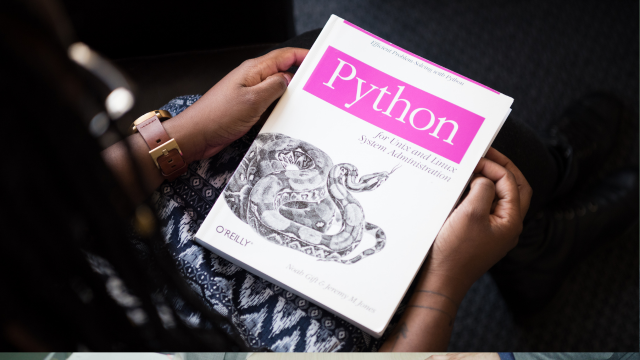
Python is used across software engineering, automation, data analysis, artificial intelligence, scientific research and many other areas of technology. Its comparatively readable syntax also makes it a common first language for people who want to learn programming without beginning with unnecessary complexity.
For people comparing Python courses UK providers offer, however, learning the syntax is only the beginning. Professional programmers also need problem-solving ability, debugging, version control, testing, data structures and experience building real projects.
The right course therefore depends on the goal. A complete beginner may need basic coding skills, while an analyst may want Python for data processing and an experienced developer may concentrate on web frameworks, automation or AI. This guide compares learning routes, certifications, tools and career opportunities while explaining how Python fits into modern software development.
What Are Python Courses and Why Are They Important?
Python courses teach learners how to write programs using the Python programming language. These Python training courses help learners develop coding and programming knowledge from basic to more advanced levels.
At beginner level, a course may introduce variables, data types, conditions, loops and functions. More advanced programmes can cover object-oriented programming, databases, APIs, testing, web development, automation, machine learning or data science.
Python is described as a general-purpose programming language because it is not limited to one task. It can be used for software development, automation, data analysis, artificial intelligence and web applications.
A developer might use Python to create the back end of a web application. A data analyst might use it to clean thousands of rows of information. An engineer might automate repetitive technical processes, while researchers can use specialist libraries to analyse scientific data.
This flexibility makes Python useful both as a first programming language and as an additional coding tool for experienced technology professionals.
Learning Python also introduces broader programming and software development concepts.
A learner needs to understand how to:
- break a problem into smaller tasks;
- represent information using appropriate data types;
- make a program respond to different conditions;
- repeat operations efficiently;
- organise reusable code;
- identify and handle errors; and
- test whether a solution produces the expected result.
These principles transfer to other programming languages.
That is why good programming courses UK learners choose should not focus only on memorising Python courses UK commands. The aim should be to understand why a particular piece of code works and how to design a solution when the answer has not already been provided. This develops practical coding knowledge, programming ability and problem-solving skills.
Why Python Skills Are in Demand in the UK
Python sits within a wider UK demand for software, data and digital capabilities. Skills England’s 2026 assessment identifies programmers and software-development professionals as one of the most important digital occupations. The occupation appears among priority roles across seven sectors, illustrating how software expertise is needed beyond technology companies alone.
Financial services, life sciences, defence, creative industries and advanced manufacturing all require software professionals.
Python is relevant because the language can support work across many of these environments. A financial organisation might use Python courses UK for analytics or automated processes. A life-sciences business can use it in bioinformatics or machine learning. Technology companies may use Python courses UK for web services, data platforms or testing.
The National Careers Service currently gives software developers an indicative earnings range of around £30,000 to £75,000, while its data-scientist profile gives roughly £32,000 to £83,000.
These figures should not be interpreted as salaries available simply because somebody completes a Python courses UK course.
Employers usually recruit for a role rather than for knowledge of one language. A software developer may also need:
- algorithms and data structures;
- databases;
- Git;
- software testing;
- APIs;
- cloud technology; and
- knowledge of development practices.
A data scientist may additionally need mathematics, statistics, machine learning and domain knowledge.
Python courses UK is therefore a valuable component of employability rather than a complete career qualification by itself. It should be viewed as one part of a wider programming skill set and technical skill base.
There is another important change underway.
Skills England reports that AI-assisted code generation is increasingly mainstream and expects some routine coding and testing activities to move towards automation. Human professionals may consequently spend more time reviewing generated code, validating systems, understanding requirements and making decisions.
Future programmers will need to know how to code while also understanding whether automatically generated code is correct, secure and maintainable.
Essential Python Skills to Learn
A useful Python curriculum should progress from syntax towards independent problem-solving. Good Python courses UK programming training should gradually develop both technical knowledge and practical coding ability.
Variables and data types
Beginners first need to understand how programs store information.
Python courses UK includes data types such as:
- integers;
- floating-point numbers;
- strings;
- Boolean values;
- lists;
- tuples;
- dictionaries; and
- sets.
The objective is not to memorise definitions.
Learners need to understand which structure is appropriate for a particular problem. A list may be suitable for an ordered collection of values, while a dictionary can associate keys with corresponding information.
Conditions and loops
Programs need to make decisions.
Conditional statements allow different code to run according to whether a particular condition is true. Loops allow operations to be repeated without manually writing the same instruction many times.
Learners should become comfortable deciding when repetition is appropriate and how to avoid creating unnecessary or infinite loops.
Functions
Functions organise code into reusable units. Instead of writing the same logic repeatedly, a programmer can define a function and call it when required.
This introduces important concepts such as parameters, arguments, return values and scope.
Well-designed functions also make programs easier to test, maintain and reuse.
Error handling
Real programs encounter problems. A file may not exist. A user may enter invalid information. A network request may fail.
Python provides exceptions and error-handling mechanisms that allow software to respond appropriately.
Beginners should learn not only how to prevent programs from crashing but also how to identify the underlying reason for an error. This supports better debugging and troubleshooting skills.
Object-oriented programming
Object-oriented programming, or OOP, becomes relevant as learners progress beyond small scripts.
Classes and objects can help organise related data and behaviour. Not every Python courses UK problem requires a class, so learners should understand when object-oriented design adds value rather than applying it mechanically.
Files and data handling
Python is frequently used to read and manipulate information stored in files.
Learners may work with:
- text files;
- CSV data;
- JSON; and
- structured data from APIs.
These skills become particularly important for automation, data processing and analytical tasks.
Testing
Testing is one of the areas beginners often overlook.
A program working once with one example does not demonstrate that it works reliably. Learners should gradually develop the habit of testing different inputs and edge cases.
Professional developers may use frameworks such as pytest to automate these checks and improve software reliability.
Version control
Git is not part of Python itself, but it is highly relevant to professional development.
Version control allows programmers to track changes, collaborate with others and recover previous versions of work.
Someone hoping to move beyond beginner coding should learn Git relatively early rather than waiting until after completing several programming courses.
Best Python Courses in the UK for Beginners and Professionals
There is no single course that can be called the best for every learner.
A free introduction may be entirely appropriate for somebody deciding whether they enjoy coding. Someone moving into professional data analysis needs considerably more depth and specialist data analysis skills.
| Learning route | Current example | May suit |
| Short beginner course | University of Leeds via FutureLearn | Complete beginners |
| Free introductory study | OpenLearn Simple Coding | Learners testing basic Python concepts |
| Short commercial training | Tyne Academy Python courses | Learners seeking brief self-paced introductions |
| Data-focused study | Oxford Python/data-science courses | Learners moving towards analytical applications |
| Certification preparation | Python Institute PCEP/PCAP learning | Learners wanting structured Python certification |
University of Leeds introductory Python course
The University of Leeds currently offers An Introduction to Programming Using Python courses UK through FutureLearn.
It is designed as an introductory programme and covers subjects such as:
- programming and algorithms;
- Python syntax;
- variables;
- logic;
- primitive data types;
- input and output; and
- creating simple programs.
The course is structured over approximately two weeks at around three hours of learning per week.
This can suit beginners who want a structured introduction without initially committing to an extensive programme.
A short introductory course should still be understood as the beginning of programming study rather than preparation for immediate professional employment.
Open University OpenLearn
OpenLearn offers free introductory coding material using Python. Its Simple Coding course introduces Python courses UK programs, instructions and repetition.
The advantage is accessibility. Learners can experiment without committing significant money.
OpenLearn also states clearly that completing its free courses does not produce an Open University qualification. Learners may receive a Statement of Participation or, on selected courses, a digital badge.
This distinction is useful when comparing online course marketing. Evidence of learning can be valuable without being a formal qualification or regulated credential.
Python for data science
Learners interested in data science training need more than basic Python courses UK syntax.
Useful topics can include:
- NumPy;
- pandas;
- data cleaning;
- visualisation;
- statistics;
- Jupyter notebooks; and
- machine learning.
Oxford University’s continuing-education material provides one example of this more specialised direction, with Python courses covering data collection, preprocessing, exploratory analysis and libraries used in analytical workflows.
The University of Leeds also currently provides Python with Jupyter learning designed as an introduction to data-oriented programming.
A beginner should normally become comfortable with ordinary Python fundamentals before trying to learn machine learning simply because it is popular.
Tyne Academy
Tyne Academy currently advertises Python Programming for Beginners and Python courses UK Developer Training through Reed.
The beginner programme covers introductory Python syntax and core concepts and is currently listed at around 1.1 hours of self-paced study.
Tyne Academy also markets coding programmes that combine Python with technologies such as HTML, JavaScript, SQL and PHP. These can provide brief introductory exposure and may suit someone exploring whether programming interests them.
However, the qualification wording needs careful treatment.
Reed explicitly describes the reviewed beginner Python courses UK programme as providing no formal qualification, with a certificate of completion instead. Some Tyne Academy course titles also use level terminology, but learners should not assume that a course described as “Level 3” is a regulated Level 3 qualification unless the awarding organisation and regulatory status can be independently verified.
For someone seeking professional software development capability, a course lasting approximately an hour should therefore be treated as a starting point rather than complete career preparation.
Python Certifications and Professional Development

Python does not have a statutory professional licence.
A person does not need a government-issued Python certificate before working as a programmer. This means certifications are optional evidence of skills rather than legal permission to practise.
PCEP
The OpenEDG Python Institute currently offers the PCEP – Certified Entry-Level Python Programmer credential.
It assesses fundamental programming concepts including:
- Python syntax;
- variables and data types;
- control flow;
- collections;
- functions; and
- exception handling.
It can provide a structured objective for beginners who want an externally administered Python examination.
PCAP
PCAP – Certified Associate Python Programmer is positioned at a higher level.
Current assessment includes object-oriented programming, modules, packages, exceptions, file processing, generators and related intermediate Python topics.
The active PCAP-31-03 examination is currently valid within the certification framework for five years after achievement.
Learners should check the current examination version before preparing because Python courses UK Institute has been developing updated exam versions during 2026.
Specialist Python credentials
Python Institute has expanded beyond general programming.
Its current certification tracks include credentials related to:
- data analysis;
- software testing;
- security;
- automation; and
- artificial intelligence.
This reflects how Python is used in several different technology specialisms and digital career pathways.
Certification versus regulated qualification
PCEP or PCAP can demonstrate performance against Python Institute’s certification requirements.
They are not automatically equivalent to a GCSE, A level, Higher Technical Qualification or university degree in the UK.
Likewise, a course-completion certificate from an online provider is different from passing an externally administered certification examination.
Candidates should therefore decide what they actually need.
For many software-development applications, a strong GitHub portfolio and evidence of practical projects may be at least as relevant as an entry-level language certificate.
Python Tools, Frameworks, and Development Techniques
Professional Python courses UK involves an ecosystem of tools rather than the language alone. Developing Python coding skills therefore includes learning appropriate development environments, libraries, frameworks and techniques.
Python interpreter and environments
As of September 2026, Python 3.14.7 is the latest stable release.
Python 3.15 is currently in release-candidate status, with the final version scheduled for October 2026.
Beginners should generally work with a supported stable Python courses UK 3 version unless their course requires something different.
Virtual environments are also useful because different projects may require different versions of third-party packages.
Python courses UK pip
Python’s package ecosystem allows developers to install reusable libraries.
pip is commonly used to install packages. Learners should understand that installing a package introduces an external dependency and should use reputable sources and maintain dependencies carefully.
Visual Studio Code
VS Code is widely used for Python development and is used within current University of Leeds introductory teaching.
It provides editing, terminal integration and extensions that can make development easier. Other tools such as PyCharm are also commonly used.
The important skill is understanding the code rather than depending entirely on one editor.
Jupyter
Jupyter notebooks are particularly useful for interactive analysis.
They allow code, results and explanation to appear in the same document. This makes them common in data science training, research and exploratory work.
For larger production applications, ordinary source files and structured software projects may be more appropriate.
Git and GitHub
Git tracks code changes.
GitHub and similar services allow repositories to be hosted and shared.
Aspiring developers can use public repositories to demonstrate projects, provided they do not expose passwords, private information or copyrighted material they do not have permission to publish.
Django
Django is a mature Python framework for building web applications.
It provides substantial built-in functionality and can suit larger structured web projects.
Learning Django makes more sense once a learner understands Python courses UK fundamentals and basic web concepts.
Flask and FastAPI
Flask provides a relatively lightweight route into Python courses UK web applications and APIs.
FastAPI is widely used for developing modern APIs and services.
Learners should understand HTTP, request handling and application design rather than focusing only on framework syntax.
NumPy and pandas
NumPy supports numerical computing.
pandas provides powerful tools for tabular data and analysis.
They are particularly relevant for analysts, researchers and learners progressing towards data-science work.
Testing and code quality
Tools such as pytest help developers automate testing.
Linters, formatters and type-checking tools can also improve code quality.
Professional coding skills therefore extend beyond producing output: code should be understandable, testable, reliable and maintainable.
Career Opportunities After Python Courses
Python supports several career directions, although the job title “Python developer” represents only one possibility.
Software developer
Software developers design, create and test applications.
Python may be their primary language or one of several technologies they use.
The National Careers Service identifies university, college, apprenticeship and graduate-training routes into the profession.
Python training can support this pathway, but software engineering also requires broader development knowledge and technical skills.
Back-end developer
Back-end developers work on the server-side logic behind websites and applications.
Python frameworks such as Django, Flask and FastAPI can be relevant.
These roles may also require databases, APIs, cloud deployment, security and testing skills.
Data analyst
Python courses UK can help analysts clean information, automate repetitive work and perform more complex analysis.
SQL, spreadsheets and business-intelligence tools may be equally important depending on the employer.
Python therefore works well as part of a wider data analysis, programming and digital skills toolkit rather than as a standalone career qualification.
Data scientist
Python is widely used in data science and machine learning.
The National Careers Service describes data scientists as professionals using software, AI and machine-learning methods to interpret large quantities of data.
This career typically requires stronger mathematics, statistics and analytical knowledge than a basic Python course provides.
Machine-learning engineer
Machine-learning engineers build and deploy systems using trained models.
Python is common in this field because of libraries and frameworks supporting AI development.
The role requires substantially more than learning Python syntax, including software engineering, data handling and machine-learning concepts.
Test automation engineer
Python can be used to automate software testing.
Someone interested in this route may learn testing frameworks, browser automation, APIs and continuous integration alongside Python.
DevOps and automation roles
Python scripts can automate system administration, cloud and deployment tasks.
Professionals in DevOps or platform engineering often combine programming with Linux, networking, cloud services and infrastructure tools.
Cyber-security roles
Security professionals may use Python courses UK to automate analysis or develop internal tools.
Cyber-security work requires additional knowledge of systems, networks, legal boundaries and security methodology.
Python is the tool, not the complete profession.
How to Build a Successful Career Using Python

Learning syntax should lead quickly into practical work.
Start with fundamentals
Do not rush into artificial intelligence before understanding variables, functions, loops and data structures.
Strong fundamentals make advanced libraries easier to understand.
Write code regularly
Programming is learned through practice.
Small exercises are useful at the beginning, but learners should gradually build complete projects.
A beginner project might:
- organise personal expenses;
- analyse a public dataset;
- rename files automatically;
- create a simple API; or
- build a small command-line application.
Learn to debug
Errors are part of programming.
Instead of immediately asking an AI assistant for the answer, read the error message, identify the relevant line and form a hypothesis about what went wrong.
Debugging ability is one of the clearest differences between somebody who has watched programming tutorials and somebody who can work independently.
Learn Git
Use version control on personal projects.
Make meaningful commits and learn how branches and merges work.
This helps prepare for collaborative software development.
Build a portfolio
A portfolio should show quality rather than quantity.
Three well-documented projects can be more convincing than 30 tutorial copies.
For each project, explain:
- the problem;
- the approach;
- technologies used;
- how to run it; and
- what you would improve.
Choose a specialism
Once the foundations are secure, move towards a specific career direction.
For example:
Web development: Python → HTTP → databases → Django/FastAPI → testing → deployment.
Data: Python → SQL → NumPy/pandas → statistics → visualisation → machine learning.
Automation: Python → APIs → operating systems → cloud tools → testing.
A focused route is usually more productive than attempting every Python application simultaneously.
Apply for broader technology roles
The first job does not need to contain “Python” in its title.
Junior developer, data analyst, QA automation, technical support or adjacent digital roles can provide experience from which programming responsibilities expand.
Future Trends in Python Programming and Software Development
Python development is changing alongside the wider software industry.
AI-assisted coding
AI code-generation tools are now a normal part of many development workflows.
Skills England’s 2026 analysis says code generation and translation are becoming mainstream and that agentic systems are beginning to review, merge and deploy code.
This changes what employers may expect.
Developers increasingly need the ability to:
- inspect generated code;
- identify incorrect assumptions;
- test behaviour;
- assess security;
- verify dependencies; and
- explain what the code actually does.
Someone who can generate Python but cannot understand it remains dependent on the tool.
Python and artificial intelligence
Python remains strongly connected with AI and machine learning through libraries and frameworks used in research and production.
This makes Python a logical language for people moving towards AI, but serious data science training still requires mathematics, data quality, evaluation and domain understanding.
Knowing how to call a model library does not automatically make someone a data scientist.
Changes to Python itself
Python continues to evolve.
Python 3.14 is the stable feature series at the time of writing, while Python 3.15 is due for final release in October 2026.
Python 3.14 officially supports free-threaded Python, a significant development in the language’s approach to concurrency.
Learners do not need to chase every new feature immediately. Maintaining knowledge of supported versions and reading release notes becomes more important as professional experience grows.
More emphasis on software quality
If AI makes basic code easier to produce, the ability to judge quality becomes more valuable.
Testing, architecture, security, documentation and maintainability are likely to differentiate experienced developers increasingly.
Hybrid technical roles
Python can connect programming with domains that were traditionally separate.
Scientists, financial analysts, engineers and marketers can automate tasks without becoming full-time software engineers.
This may increase demand for professionals who combine domain expertise with competent programming.
Continuous learning
Frameworks and libraries change much more quickly than fundamental programming concepts.
A sustainable career therefore depends on the ability to learn new technology rather than permanently relying on the first framework studied.
Key Takeaways
Python is a versatile general-purpose language used in software, data, automation, AI, testing and many other technical fields.
Beginners should prioritise variables, data structures, conditions, loops, functions, errors and practical problem-solving before moving into specialist frameworks.
There are many ways to study Python in the UK, including short university-backed courses, free OpenLearn resources, commercial online programmes and certification-focused learning.
Tyne Academy provides brief beginner and developer-focused Python courses that may introduce the subject, but the reviewed offerings provide completion certificates rather than formal qualifications.
Python Institute credentials such as PCEP and PCAP provide a different form of professional certification, although they are not regulated UK qualifications.
Most importantly, employers generally need evidence that a candidate can apply Python to genuine problems. Projects, debugging, Git, testing and specialist knowledge therefore matter alongside formal learning.
FAQ
What are Python courses?
Python courses teach programming using the Python language.
Beginner programmes normally cover syntax, variables, data types, conditions, loops and functions. Intermediate and advanced courses may include object-oriented programming, testing, web frameworks, databases, automation, data analysis and machine learning.
The depth can range from an hour-long introduction to a university degree containing substantial programming study.
Why should I learn Python?
Python can introduce fundamental programming concepts while supporting practical applications in web development, data analysis, automation and AI.
Its relatively readable syntax makes it a popular starting point.
Learning Python can strengthen coding skills, but employers may require additional technical and professional abilities depending on the job.
Which Python course is best?
There is no universally best course.
Complete beginners may benefit from the University of Leeds introductory FutureLearn course or free OpenLearn material. Learners interested in data can progress towards university or specialist data science training, while those seeking certification can investigate PCEP and PCAP.
Tyne Academy’s short courses may suit learners wanting a quick introduction.
The best option depends on depth, practical exercises, assessment and career objective.
What skills are required to learn Python?
Beginners do not normally need previous programming experience.
Useful qualities include logical thinking, persistence and willingness to practise.
As learners progress, they should develop debugging, testing, Git, data structures and problem-solving ability.
More specialised careers may require mathematics, databases, web technologies or cloud skills.
Are Python jobs in demand in the UK?
Python-specific vacancy demand varies, but the broader outlook for programmers and software-development professionals remains significant.
Skills England currently identifies software development as a priority occupation across several UK sectors and forecasts substantial growth to 2035.
The projections are uncertain because AI is changing coding work, so applicants should develop broader software-engineering capability rather than relying on knowledge of one programming language.
Which Python certifications are valuable?
Python Institute currently offers PCEP for entry-level learners and PCAP for associate-level programmers, alongside specialist certification tracks.
These can provide structured evidence of Python knowledge.
They are professional/vendor credentials rather than regulated UK qualifications.
For many roles, employers will also want practical projects and evidence of relevant technical experience.
What careers are available after learning Python?
Python can contribute to careers in software development, back-end engineering, data analysis, data science, machine learning, automated testing, DevOps, cyber security and scientific computing.
Each field requires additional specialist knowledge.
Completing a Python course therefore provides a foundation rather than automatic qualification for all of these careers.
Can Python courses improve career opportunities?
They can help develop useful technical skills and provide structured evidence of learning.
Career benefits are strongest when course study is combined with regular coding, portfolio projects, Git, testing and knowledge relevant to a particular occupation.
No Python course can guarantee employment, promotion or a particular salary.

Conclusion
Python provides one of the more accessible entry points into programming while remaining capable enough for substantial professional applications. It is used across web technology, automation, AI, analytics and scientific computing, making it relevant to beginners as well as experienced professionals.
For learners comparing Python courses UK, the best approach is to match training to the intended outcome. General programming courses UK learners take should establish algorithms, debugging and software fundamentals, while people moving towards analytics will need deeper data science training alongside Python.
Tyne Academy currently offers short self-paced Python learning for beginners and developing programmers. These programmes can provide an introduction and support the development of basic coding skills, but their completion certificates should not be confused with regulated qualifications or proof of professional programming competence.
A successful route into software development normally requires much more practice. Learners should build projects, use Git, test their code, learn relevant frameworks and develop the ability to solve unfamiliar problems independently.
AI is changing how code is created, but that makes understanding software more rather than less important. Professionals who can use Python, evaluate AI-generated work and apply sound engineering judgement are likely to be better prepared for the next stage of the UK’s rapidly changing digital economy.